It is easy to look at a collapsing world and search for a villain.
In classic epic fantasy, we are conditioned to point toward an active, singular malice a dark lord, a cosmic curse, or a catastrophic war between ultimate good and ultimate evil. We want structural collapse to be loud, intentional, and easily blamed.
But in the universe of When Gods Fail, the tragedy is far quieter, far more intimate, and infinitely heavier.
Worlds do not fail because of a sudden influx of darkness. They fail because something foundational, something entirely vital, was left out of the design from the very first moment of creation.
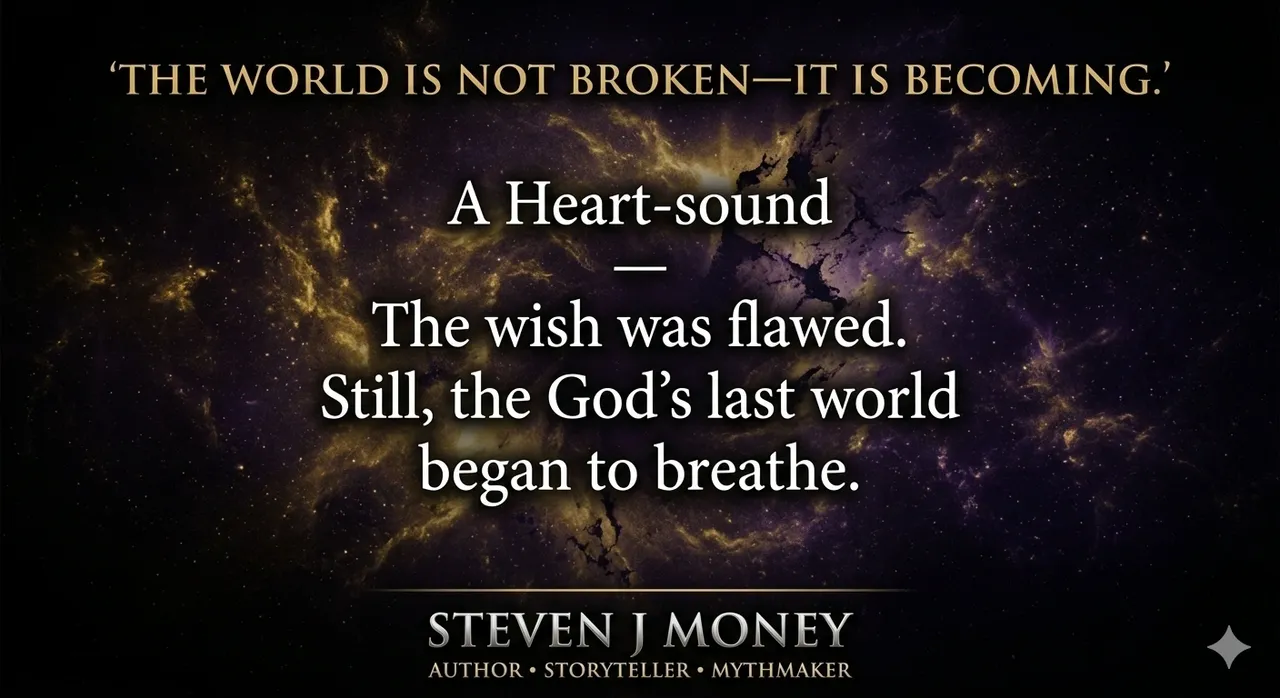
A Heart-sound: The wish was flawed. Still, the God’s last world began to breathe.
Beyond Simple Conflict
This fragment carries the true emotional frequency of the trilogy. It steps entirely away from traditional tropes to explore a fragile, agonizing boundary line: the space between an imperfect creation and a creator who possesses immense, reality-bending power but zero instinctive understanding of life’s value.
When a design is fundamentally missing an essential element, the structure cannot endure unchanged. The resulting cataclysms are not punishments or cruel cosmic acts. They are growing pains.
The fractures, the decay, and the shifting weights of the world are part of a raw, subconscious metamorphosis. The universe itself is acting as the primary character, stumbling blindly through the dark, trying to figure out how to survive its own design defects.
The Transition Toward Emergence
To see ruin and assume it is a conclusion is to misunderstand the cycle of things.
We are tracking a transition from suppression toward emergence. The heavy, old-world weight the decay of the old systems must be sat with before the atmosphere can soften. Before the light can be held again, the cracks must show exactly where the foundation was weak.
The world is not broken. It is learning how to hold its shape.